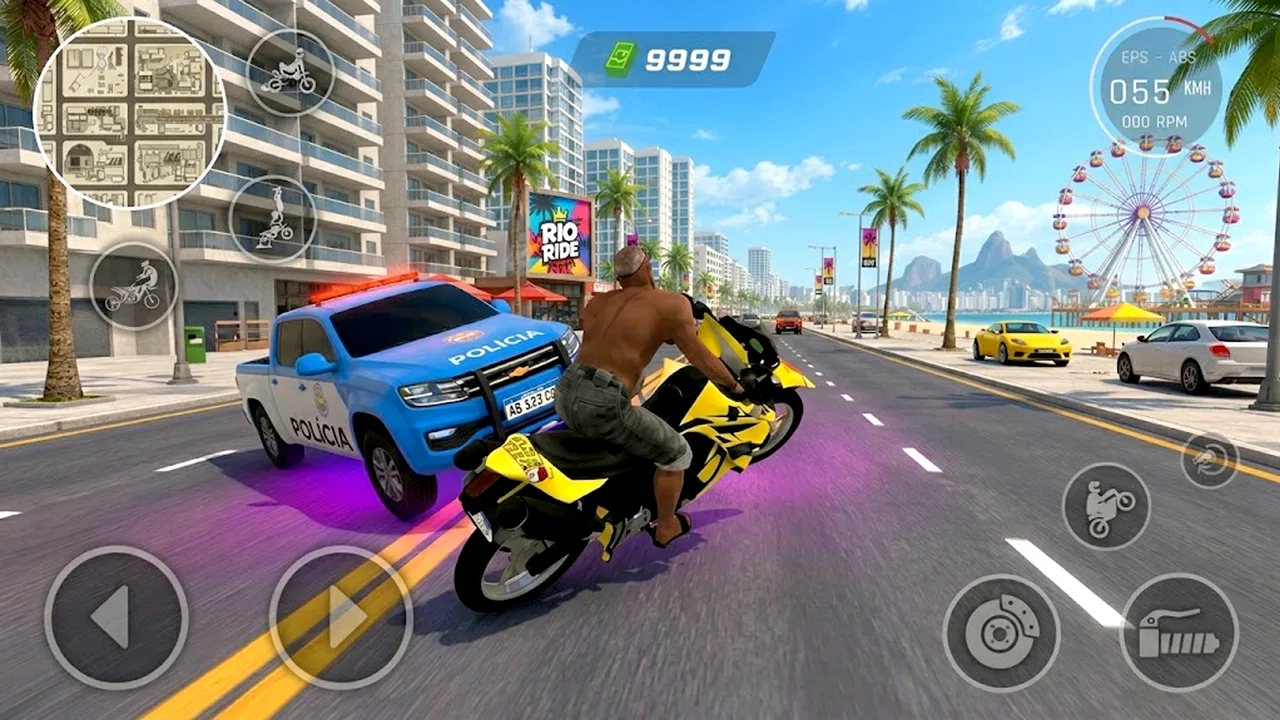
Moto Wheelie: Traffic Bike 3D
- 4.5
- Rating
- 1.00M
- Installs
- Free
- Price

 Analysis by App-foxy
I spent time with Moto Wheelie: Traffic Bike 3D as a quick, skill-focused racing game, and its appeal became clear almost immediately: it asks me to control a motorcycle while keeping a wheelie going through traffic. That simple idea creates a surprisingly tense rhythm. I am not just steering from one point to another; I am constantly balancing control, timing, and the temptation to push a little farther.
The game is made by KangBang Games and is free to play. It is listed for Everyone, which fits the straightforward nature of the experience. The current version is 1.1.2, and it runs on devices using Android 7.0 or later. With an average score of 4.6 from around 1.4 thousand ratings and more than a million installs, it has clearly found an audience among players who enjoy short motorcycle challenges rather than large, story-heavy racing games.
What the wheelie-focused design feels like in practice
The most important thing to understand is that this is not trying to be a conventional circuit racer. In a typical racing game, I think about braking points, cornering lines, lap times, and overtaking. Here, the central question is different: how long can I maintain a controlled wheelie while still reacting to the road and surrounding traffic?
You May Also Like

 Blood Strike: 2.5 Anniversary
Blood Strike’s Loadouts Turn Every Drop Into a Tactical Gamble
A close look at Blood Strike’s custom loadouts: how fast access to signature weapons reshapes its battle royale rhythm, rewards preparation, and narrows the gap between fights.

 Pandora - Music & Podcasts
Pandora’s Music Is Easy to Start, but Harder to Recover
Pandora’s strength is its low-effort path from a seed to a station. Its weak spot is how much confidence it asks you to place in connection, setup, and quiet recovery.

 8 Ball Pool
 Is Built on Rivalries, Rematches, and Routine
A close look at the rivalries, rematches, shared routines, and unanswered safety questions that turn a quick pool match into a persistent mobile community.

 Samsung Music
’s Quiet Strength Is Playing What You Already Own
Its reach comes less from spectacle than from dependable access to a personal library. That simplicity is both the app’s strongest retention engine and its ceiling.

 AccuWeather: Weather Radar
AccuWeather Review: A Quick, Clear Forecast for Everyday Decisions
For everyday plans, the best forecast is the one you can understand quickly. AccuWeather makes rain timing, radar, and local conditions easy to act on, with a few trade-offs.

 Hill Climb Racing
Why Hill Climb Racing Still Turns Crashes Into One More Run
A tiny car, a bumpy hill and one more upgrade: Hill Climb Racing keeps resurfacing because its simple chaos makes every near-miss feel personal.
More From Our News Desk
View All News


That change in emphasis makes each attempt feel more immediate. A small mistake can ruin a good run, but the controls are easy to understand at a glance. I do not need to learn a complicated vehicle setup before enjoying the main challenge. The satisfaction comes from gradually becoming more comfortable with the bike’s balance and from recognizing when a risky move is worth attempting.
The traffic setting also gives the game a useful sense of pressure. Empty road would make the wheelie mechanic feel like a practice exercise, while a crowded route forces me to divide my attention. I have to watch the bike’s position, judge the available space, and decide whether to preserve a stable run or chase a more impressive moment. That is where the game feels more like a test of concentration than a basic driving toy.
The best way to play is to treat every run as a balance exercise first and a speed challenge second. When I focus only on going quickly, I make impatient corrections. When I keep the bike calm and leave myself room to react, the ride becomes much more consistent. This is a useful distinction for new players because the game’s premise sounds reckless, but success usually comes from controlled decisions.
A practical routine for improving your runs
My most useful approach was to begin conservatively. Instead of trying to hold the longest possible wheelie immediately, I concentrated on keeping the motorcycle stable through the opening part of a run. That gave me time to settle into the controls and observe how traffic affected my choices. Once the basic movement felt predictable, I could attempt longer balances without turning every mistake into frustration.
Another helpful habit is to avoid making several corrections at once. If I react to traffic, adjust the bike, and try to extend the wheelie in the same moment, the result is usually messy. Separating those decisions works better: first create enough space, then restore balance, and only afterward decide whether to continue pushing. This is not a flashy trick, but it makes the game feel less random.
I also found that short sessions suit the design particularly well. A few attempts during a commute break or while waiting for an appointment provide enough time to chase improvement without requiring a long commitment. The game is easy to pick up, but its balance challenge gives repeated attempts a purpose. I am usually trying to beat my own previous performance rather than completing a long campaign.
That structure will appeal to players who like retry-based games. It may be less suitable for someone looking for a broad career mode, deep customization, or a large collection of race types. The attraction here is the repeated refinement of one distinctive skill. If that loop does not sound enjoyable, realistic bike presentation alone will not make the experience feel varied.
Where the pressure comes from
The pressure in Moto Wheelie: Traffic Bike 3D does not come from complicated menus or a demanding story. It comes from the conflict between control and ambition. I can often maintain a safer ride by being cautious, but cautious play may feel less rewarding when I know I could extend the wheelie. That creates a natural risk-and-reward decision without needing elaborate rules.
This also affects how progress feels. Even when a run ends quickly, I can usually identify the reason: I reacted too late, left too little room, or tried to recover an unstable position instead of resetting my approach. That clarity is valuable. A failed attempt feels more useful when I can change one behavior in the next run.
There is a trade-off, though. A focused mechanic can become repetitive for players who need constant novelty. The game’s strength is that it keeps returning to the wheelie challenge, but that is also its main limitation. I would recommend it to someone who enjoys polishing a small skill over many attempts, not to someone who expects every session to introduce a new system.
Fairness, spending, and what a player can judge
The game is free, so it is reasonable to consider whether spending affects the experience. From the purchase context available around this release, I would not make claims about particular paid items, subscription terms, or advantages without seeing them directly in the game. The responsible conclusion is simple: enjoy the free entry point, and examine any purchase screen carefully before confirming anything.
That does not make the game difficult to assess. The core question is whether the wheelie-and-traffic challenge feels enjoyable without requiring payment. For me, the basic appeal comes from learning the handling and improving my decisions, so the game can be worthwhile as a free casual racer even before considering optional spending. I would still avoid assuming that every progression or reward element is purely skill-based unless the current in-game presentation makes that clear.
Players who are careful with spending should use a practical rule: do not buy something merely because a difficult run feels frustrating. In a game built around repeated balance attempts, failure is part of the learning loop. Waiting until I understand what a purchase changes, whether it is permanent, and whether it affects progression helps separate a genuine convenience from an impulse decision.
That matters especially for younger players. The Everyone rating describes the game’s general content, but it does not replace household rules about purchases or screen time. I would let a child play the free portion first, then review any transaction prompt together. The game’s accessible premise makes it easy to hand over, but spending decisions still deserve adult attention.
How it compares with ordinary racing alternatives
Compared with a standard traffic racer, this game gives me a narrower but more memorable objective. Conventional alternatives usually reward staying fast, overtaking smoothly, and surviving a route. Moto Wheelie: Traffic Bike 3D adds a stunt-oriented layer, so the best run is not simply the one with the highest speed. It is the one where I keep the motorcycle composed while dealing with hazards.
Compared with a full motorcycle simulator, it is easier to approach and more immediately focused. A detailed simulation may offer more mechanical depth, tuning, or realistic riding tasks, but it can also demand more time before the controls feel comfortable. This game makes a stronger case for quick sessions and repeated attempts. I would choose it when I want a direct challenge rather than a complete virtual garage.
Compared with stunt games that use exaggerated physics, its traffic setting gives mistakes a more grounded context. I have to think about space and timing instead of treating every jump or crash as a spectacle. That makes the experience more disciplined, although players seeking wild tricks and constant visual surprises may prefer an arcade stunt title.
The fairest comparison is therefore about priorities. Choose this game for a compact motorcycle challenge built around wheelie control. Choose a conventional racer for broader road competition, a simulator for deeper vehicle management, or a stunt-focused game for more variety in tricks. None of those choices is automatically better; they simply serve different moods.
Who will enjoy it, and who should skip it
I think it is a good fit for players who enjoy games that are easy to start but difficult to master. It works particularly well for someone who likes chasing personal improvement, replaying short attempts, and learning through small adjustments. Motorcycle fans may also appreciate that the bike itself is not just decoration; its balance is the main reason to keep playing.
It is also suitable for casual players who want a free racing game that can be opened without a long setup. The Everyone rating makes it broadly approachable, while the Android 7.0 minimum means it can run on a range of older compatible devices. I would still expect the smoothness of play to depend on the individual phone, especially in a traffic-heavy 3D scene, so closing unnecessary background apps is sensible on less powerful hardware.
I would skip it if my priority were a long-form racing career, extensive vehicle ownership, detailed online competition, or a large selection of unrelated events. The game’s identity is too concentrated for that. I would also skip it if repeated failures in a single mechanic quickly become annoying. There is no point choosing a wheelie specialist when what I really want is a varied racing package.
Small decisions that make the experience better
One non-obvious advantage of the focused design is that it gives me a clear way to measure improvement without relying on a complicated progression system. I can compare how calmly I handled traffic, how often I overcorrected, and whether I took risks at sensible moments. That makes the game useful as a short concentration exercise, not just a way to fill time.
A second insight is that playing with a “survive first” mindset changes the feel of the game. I used to treat every open stretch as an invitation to extend the wheelie immediately. A better workflow is to stabilize first, scan the road, and then choose a target. This reduces careless failures and makes successful risky moments feel earned rather than accidental.
A third trade-off concerns session length. Longer sessions can help me build familiarity, but they can also make small control errors more likely because the same balancing motion demands attention. Short bursts often produce better decisions. If I notice that I am repeatedly failing in the same way, taking a break is more useful than forcing another dozen attempts.
There is also a useful distinction between learning the bike and learning traffic judgment. I can improve my handling while still making poor decisions around nearby vehicles. Treating those as separate skills helps identify the real problem. If the bike is stable but the route choices are bad, I should focus on spacing and timing rather than changing the way I balance.
Device fit and everyday use
Because the game is free and designed around quick racing attempts, I see it fitting naturally into small gaps in the day. I might play a few runs while waiting for food, take a short break from work, or use it as a compact wind-down activity. The lack of a need for a lengthy narrative commitment is a genuine advantage in those situations.
On an Android phone that meets the 7.0 requirement, installation should be straightforward. The current 1.1.2 version gives users a clear version point to look for when checking compatibility. I would leave enough free storage for normal app installation and updates, and I would test the controls briefly before deciding whether the handling suits me.
The game is less convincing as a background activity because it asks for active attention. Traffic and wheelie balance do not combine well with distracted play. I would not recommend trying to play while walking, commuting, or doing anything that requires awareness of the surroundings. Its short-session nature is useful, but the actual riding still benefits from a focused moment.
My trust verdict after playing
Moto Wheelie: Traffic Bike 3D has a clear identity, and that is its biggest strength. It does not need to pretend to be a complete motorcycle career game. Instead, it builds its experience around one recognizable challenge and adds enough traffic pressure to make that challenge meaningful. When the controls click, a successful run feels satisfying because it reflects patience and timing rather than simple button pressing.
I also appreciate that the free price makes it easy to test the idea for myself. The rating of 4.6 and audience of over a million installs suggest strong interest, but my recommendation rests more on the design than on popularity. I would begin with the free experience, decide whether the repeated wheelie loop holds my attention, and treat any purchase prompt cautiously rather than assuming spending is necessary.
My final recommendation is positive but specific: try it if you want a focused motorcycle racing game with stunt-like balance, traffic pressure, and quick replayable sessions. It is not the right choice for deep simulation, broad competitive racing, or constant content variety. For the right player, though, its narrow goal becomes a virtue. Its best moments come from controlled risk, not uncontrolled speed.
FAQs for Moto Wheelie: Traffic Bike 3D
01What is Moto Wheelie: Traffic Bike 3D?
Moto Wheelie: Traffic Bike 3D is an arcade-style motorcycle game focused on performing wheelies while riding through traffic and avoiding obstacles. After testing it, the main appeal is its simple controls, quick races, and stunt-based gameplay rather than a realistic motorcycle simulation. It is designed for short play sessions, with the challenge increasing as you try to maintain balance, pass vehicles, and achieve higher scores.
02How do you play Moto Wheelie: Traffic Bike 3D?
Gameplay is easy to understand, although controlling the bike for a long wheelie can take practice. You generally use touch controls to accelerate, steer, and keep the motorcycle balanced while moving through traffic. The objective is to travel as far as possible, avoid collisions, and perform impressive stunts. New players should begin carefully, because holding the wheelie too long or reacting late to nearby vehicles can quickly end a run.
03Does Moto Wheelie: Traffic Bike 3D require an internet connection?
The game is primarily suited to offline, casual play, so you can usually enjoy its core riding and stunt mechanics without a constant internet connection. However, some features may depend on connectivity, including advertisements, promotional content, updates, or possible online services. If you plan to play while traveling, it is a good idea to launch the game once while connected and check which features remain available in offline mode.
04Is Moto Wheelie: Traffic Bike 3D free to download and play?
Moto Wheelie: Traffic Bike 3D is generally offered as a free-to-download game, allowing players to try the main experience without paying upfront. Like many free mobile games, it may contain advertisements and could include optional purchases or unlockable content, depending on the version and platform. Before downloading, check the official store listing for current information about ads, in-app purchases, permissions, and device compatibility.
05Is Moto Wheelie: Traffic Bike 3D suitable for children and low-end devices?
The game is relatively straightforward and does not require advanced gaming knowledge, making it accessible to younger players and casual users. Nevertheless, children may encounter advertisements or purchase prompts, so parental supervision is recommended. Performance can vary by device: newer phones should provide smoother gameplay, while older or entry-level models may experience slower loading, reduced graphics quality, or occasional stuttering during play.
Pros
- Simple controls make it easy for beginners to start riding.
- Short races are convenient for quick gaming sessions.
- Traffic creates constant challenges and keeps each ride engaging.
- Bike stunts add variety beyond simply avoiding vehicles.
- Runs smoothly on many mid-range mobile devices.
Cons
- Progress can feel repetitive after playing the same traffic routes.
- Frequent ads may interrupt gameplay between attempts.
- Limited bike customization reduces long-term personalization.
- Some controls feel imprecise during fast turns and wheelies.
- The game may require extra storage for downloaded content and updates.

Moto Wheelie: Traffic Bike 3D
Gallery